



Discover an SEO roadmap to improve your site’s visibility. This essential guide shows how to create an SEO roadmap with tips, examples, and templates.

What is an SEO Roadmap?
An SEO roadmap is like a plan or schedule that helps you improve your website’s search results over time. It is a document that maps out the steps, tasks, and deadlines to help your site show up higher in search engines. In fact, experts describe an SEO roadmap as “a document that formalizes a step-by-step plan to improve your website’s search engine performance, complete with tasks, timelines, and assignees”. This means it includes what you need to do, when, and who will do it. Think of it as a project plan or schedule. For example, a simple spreadsheet can serve as your roadmap SEO plan, scheduling tasks and deadlines over time.
They are tailored to your site’s unique goals. Working toward them should ultimately help you achieve your overall business objectives. A good SEO roadmap document keeps everyone on the same page and makes sure no important steps are forgotten.
Why You Need an SEO Roadmap
Planning out your SEO actions with a roadmap for SEO can make the whole process easier and more effective. Here are some big reasons why you should use one:
- Simplifies tasks: An SEO roadmap divides the process into smaller, manageable steps. For example, instead of broadly aiming to “improve SEO,” the roadmap might start with specific keyword research before moving to optimizing individual pages.
- Focus on impact: It helps you pick actions that give the biggest boost. By planning ahead, you can prioritize tasks that yield the greatest benefits and avoid wasting time on low-impact efforts.
- Keeps things flexible: Search engines change often. An SEO roadmap is a “living document” you can update when algorithms or goals change.
- Aligns with business goals: A clear roadmap makes sure your SEO efforts match your business objectives. As Search Engine Journal notes, successful SEO efforts often start with a structured roadmap that aligns with business goals and content planning.
- Improves communication: Documenting your SEO plan helps teams and stakeholders understand what will be done. A strong strategy “aligns stakeholders, unifies teams, and sets clear expectations”. With a roadmap, everyone knows the plan and timeline.
Using an SEO roadmap means you won’t be doing random tasks. Instead, you will follow a clear path to improve your site step by step.
How to Create Your SEO Roadmap: Step-by-Step Plan
Building an SEO roadmap strategy might seem tricky, but it’s easy if you break it into steps. Here is a simple plan to follow:
Step 1: Set Clear SEO Goals
First, decide what you want to achieve. Good goals are specific and measurable (often called SMART goals). For example, if your website sells products, a goal might be “increase organic traffic by 30% in 6 months.” Semrush suggests setting goals like increasing brand visibility or leads, then making them SMART. This makes it clear when you’ve succeeded.
Example SEO goals:
- Grow organic traffic by X% in Y months.
- Rank on Google’s first page for a target keyword.
- Increase sign-ups or sales from search by a certain amount.
Write these goals down in your roadmap document so you know exactly what you’re aiming for.
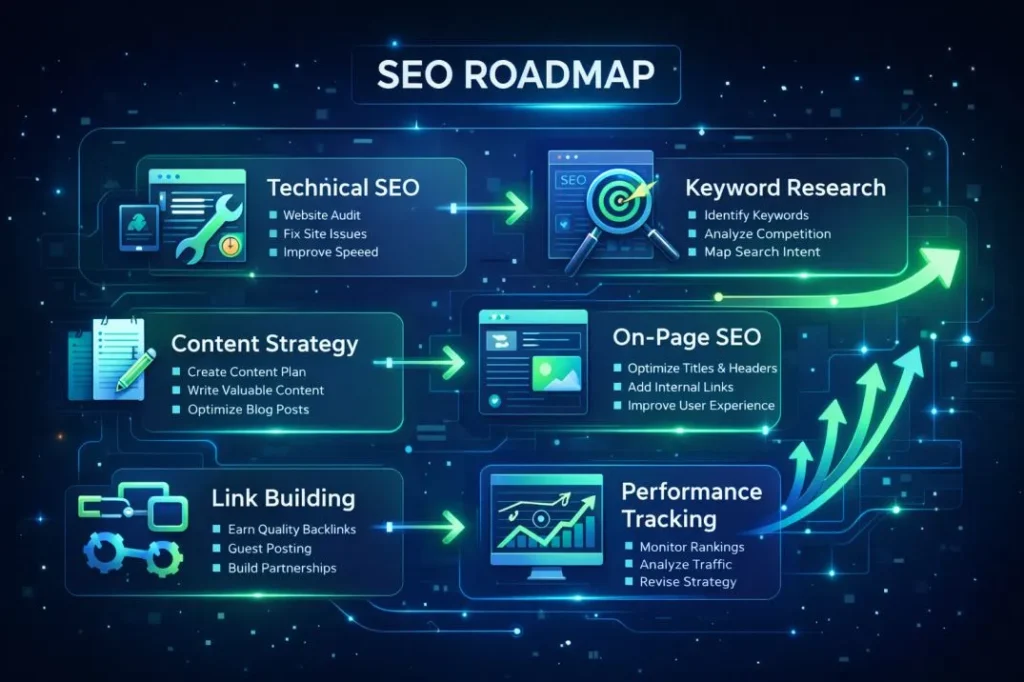
Step 2: Audit Your Website and Research
Next, look at where your site stands now. Perform a basic SEO audit:
- Technical audit: Check site speed, mobile-friendliness, and fix errors. Common issues include slow pages, broken links, or duplicate content.
- On-page audit: Examine page titles, headings, and content. Are you using your keywords? Is each page well-structured?
- Performance review: Use tools like Google Analytics or Search Console to see which pages get traffic and which keywords you rank for. This tells you what’s working and what needs help.
Note what you find. List pages with errors or missing keywords. This will guide what tasks to add to your roadmap.
Step 3: Plan Your SEO Tasks and Prioritize
Now list all the tasks you need to do based on your audit and goals. Common SEO tasks include:
- Keyword tasks: Finalize a list of target keywords and topics to focus on.
- On-page tasks: Optimize page titles, headers, and meta descriptions for your keywords.
- Technical tasks: Fix broken links, update redirects, and improve site speed.
- Content tasks: Plan new blog posts or pages on topics your audience cares about. Update existing content with new keywords or better information.
- Backlink tasks: Identify ways to earn links from other sites (guest posts, outreach, or social mentions).
Semrush gives an example list of tasks like optimizing titles, fixing crawl errors, and creating content around high-value keywords. Once you have a list, prioritize them. A common way is an “impact vs effort” matrix:
- Quick wins (high impact, low effort): Do these first (e.g., fix obvious SEO errors).
- Big bets (high impact, high effort): Plan these carefully (e.g., redesigning site structure).
- Fill-ins (low impact, low effort): Do them if you have extra time.
- Thankless tasks (low impact, high effort): Drop or delay these.
Put your top tasks into the roadmap with deadlines and who’s responsible. Your roadmap is now shaping up as a clear action list.
Step 4: Create Your SEO Roadmap Document
Turn your plan into a document or spreadsheet. Include:
- Timeline: Columns for weeks or months, showing when tasks will happen.
- Tasks and Owners: Rows for each task, with who will do it.
- Goals/KPIs: Add columns for your goals and how you’ll measure them (like target organic visitors).
- Notes/Status: Track progress and updates.
A simple example might look like:
| Month | Task | Person | Status |
|---|---|---|---|
| May | Conduct keyword research | Alex | In progress |
| May | Fix broken links | Chris | Done |
| June | Publish new content on Topic X | Sam | Planned |
| June | Update meta descriptions | Alex | Planned |
This table is your SEO roadmap document. It keeps everything organized. You can use free templates if needed. For instance, Semrush offers a free SEO roadmap template (a Google Sheet) to help beginners get started. Also see “Best Tools for Research” which explains how to compete with competitors through quick research.
SEO Roadmap Document: Update and Adapt
Remember, your roadmap should be updated as you go. Semrush advises that SEO is an ongoing process and that your roadmap should be a living document. Typically, a roadmap for SEO covers about 6–12 months. Once you finish that initial plan, review your results. Did you meet your goals? If yes, create a new roadmap building on your progress. If not, adjust your goals or tactics and revise the plan. Always include new insights. For example, if your first roadmap focused on technical optimizations, your next roadmap might prioritize creating new content and building high-quality backlinks.
SEO Roadmap Examples and Templates
Looking at examples can help you create your own roadmap. Many SEO experts share templates and sample roadmaps:
- Templates: Downloadable sheets or documents to fill in tasks and dates. (Semrush’s free SEO roadmap template is one example.)
- Example roadmaps: Visual timelines (often 6–12 months) showing how tasks might be scheduled. For example, you might see Month 1–2 for research and audit, then Month 3–5 for content creation, and so on.
A good roadmap example includes clear timelines, responsibilities, and goals. It also leaves room for updates if something changes.
Tracking and Improving Your SEO Roadmap
Once your roadmap is in action, track your progress and make improvements:
- Regular checks: Use Google Search Console and Analytics to monitor organic traffic and keyword rankings each month.
- Check milestones: Review if tasks are done on time. If not, move them to the next period.
- Revise goals: Every few months, check if your goals are still realistic. If you hit a goal early, set a new target. If not, figure out why and adjust your strategy.
- Stay updated: As search trends or algorithms shift, update your roadmap tasks. For example, if user experience metrics become important, make improving UX a priority.
Following your SEO roadmap makes it easier to see what’s working. It keeps you organized and on track to improve steadily.
Conclusion: Start Your SEO Roadmap Today!
An SEO roadmap is an essential and proven tool for beginners. With a clear plan, you avoid guesswork and focus on what really drives results. Would you be ready to get started?
Set your SMART goals, fill in your tasks, and take control of your SEO journey. With your roadmap in hand, you’re on the path to higher rankings and more traffic. Let’s build your SEO success story now!
